Why Nations Fail: The Origins of Power, Prosperity, and Poverty
Book review: Why Nations Fail
- Get link
- X
- Other Apps
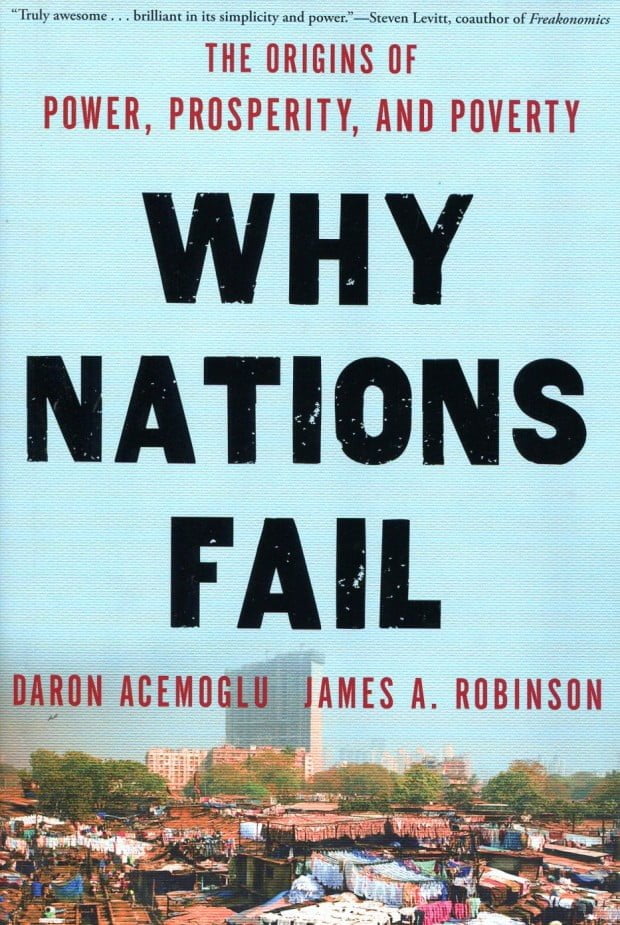 Acemoglu and Robinson argue against the “ignorance hypothesis” implicit in most development economics - that poor nations remain poor due to bad economic decisions. Rather, they propose, success and failure come down to the quality of political institutions in that country. These institutions need to be:
- Centralised enough that they can enforce the rule of law, property rights, and a monopoly on violence.
- Inclusive, rather than absolutist or extractive.
Inclusive institutions take input from a wide range of the people they govern, and uphold their rights and liberties, without seizing too much of their wealth. A lack of inclusive institutions leads to many problems:
- When a high percentage of people’s incomes are taken away (e.g. medieval serfs), that reduces their incentive and ability to invest or innovate.
- Rulers who prosper by extracting wealth from their populace are primarily concerned with remaining in power rather than improving their countries, and so block “creative destruction” and social mobility. For instance, many absolutist regimes (such as the Ottoman and Russian empires) banned the construction of railways for decades after they became common elsewhere, out of fear that they would lead to instability.
- Growth can occur under extractive institutions if they redirect resources towards important sectors - as in the Soviet Union’s space program. However, this growth is fundamentally unsustainable.
- Extractive institutions, once set up, are difficult to remove - they often survive regime changes because they are useful to the new rulers. See marketing boards in countries such as Sierra Leone, which were set up by the British to extract money from farmers, but which became even worse after independence. Or the fact that slavery flourished in Africa even after the UK and US banned the slave trade, since slaves were the backbone of agriculture.
- By contrast, Acemoglu and Robinson argue, inclusive institutions create a virtuous circle whereby most people want to uphold the rule of law since they benefit so much from it.
How well does this theory explain historical developments? The authors survey a wide range of countries. In Europe, they discuss two historical events in particular depth - the Black Death and the Glorious Revolution. The first, they argue, was a turning point which distinguished Western Europe from Eastern Europe. In both regions labour became scarce, giving serfs more power, which in Western Europe soon led to the abolition of serfdom overall. In Eastern Europe, however, landowners responded by cracking down on the rights of serfs and entrenching their own power. In this way small initial differences were amplified into disparities which persist to this day. Similarly, while similar parliaments battled similarly authoritarian rulers in France, Spain and England during the 16th century, small differences led to large divergences. England’s monarchs started out less able to monopolise income from its colonies, and unable to raise taxes without parliamentary consent. This led to more income going to merchants and opponents of the monarchy, and gradual erosion of royal power. These trends culminated in the Glorious Revolution, which placed England under the effective rule of a (relatively) pluralistic parliament, and paved the way for its dominance during the Industrial Revolution. Parliament was much less inclined to grant royal monopolies than recent kings (who had relied upon them for income), and much more open to hearing petitions from its subjects.
In Africa, by contrast, political institutions were not centralised enough to take advantage of the Industrial Revolution. Under colonialism, this did start to change, but for the wrong reasons. Firstly, institutions arose to systematically exploit the European demand for slaves (e.g. justice systems which penalised all crimes with slavery). Secondly, when colonial powers wanted to extract revenue from a population without centralised institutions, they would often empower an authoritarian leader who was tasked with collecting taxes. The institutions that formed under these leaders were fundamentally perverted by their extractiveness and lack of accountability.
It’s not just that corrupt institutions take a cut of a pie whose size is determined by economic policies. Rather, they can also nullify otherwise-useful economic reforms. For example, having an independent central bank is usually considered a valuable check on governmental power. But when the governor of the central bank of Sierra Leone criticised the corruption of its dictator in 1980, he was murdered soon afterwards. In cases like this legal changes are useless since real power lies elsewhere. And even national leaders may be hamstrung by the need to appease various power blocs - as in Ghana, where Prime Minister Kofi Busia took the IMF’s advice to implement unpopular currency reforms, and was promptly deposed by the military, who reversed the changes. These seem like paradigmatic demonstrations of why the ignorance hypothesis is a bad explanation for the poverty of states with unstable or corrupt governments - a category which includes almost all very poor states.
Overall, I think the key idea of this book is important and underrated. It’s the sort of claim which is very obvious in hindsight, but which I’d somehow managed to avoid integrating into my worldview until now (although I explored some related ideas in a previous blog post - and in fact Why Nations Fail fits nicely into the conflict/mistake dichotomy I discuss in that post). The historical coverage is also very broad, and I haven’t done justice to it in this summary by a long shot. The main flaw, however, is its presentation of its claims as narratives rather than hypotheses. In doing so, the book made its arguments more dramatic but also borderline unfalsifiable. A few examples which showcase this effect: the claim that Rome becoming politically absolutist was what led to its fall (400-odd years later); the way in which the empowerment of serfs in Western Europe and the disempowerment of serfs in Eastern Europe after the Black Death are both used to argue for the same overall hypothesis; and the description of China’s economic takeoff as primarily driven by political changes. The last is true at one level of description, since it was sparked by Deng Xiaoping’s rise to power. However, since policy changes will very often be accompanied by political shifts, I think more work needs to be done in specifying what it would mean for the authors' political institutions hypothesis to be false. After all, the political institutions which brought Deng Xiaoping to power, and which he used to turn China around, were exactly the same ones which Mao had controlled: the stark differences between the two leaders were very much due to their different ideas. Other Asian tigers are even clearer examples of when new policies, not new institutions or new political systems, were the driving force behind great reductions in poverty.
A similar ambiguity is present in the authors' discussion of culture - while they reject cultural differences as the main explanation for why some nations prosper and others fail, they ignore that culture is critical to the functioning of political institutions. For example, in some countries corruption is common at all levels of government, and bribing officials to get things done is a normal part of life. In others, bribery is totally unacceptable - and those countries are much better off as a result. Yet I doubt that the authors have any principled way of determining whether examples like this one showcase differences in political institutions which support their hypothesis, or differences in culture which rebut it. If they do, it's never explained in the book.
One last thing I’ve been speculating on: in the book, ‘absolutist’ and ‘extractive’ are used nearly interchangeably, because historically, any groups not represented in political processes got screwed over. But is the last century or so the first in which extractive non-absolutist regimes played an important role? Modern Western states are non-absolutist because all adults get to vote. But they’re extractive because they’re so large. If you add up income taxes, VAT, corporate taxes, payroll taxes, property taxes, and all the others, it wouldn’t surprise me if the average person loses more than 50% of their potential income to the government - a burden comparable to that of medieval serfs. It’s true that today we get services for that money - but we also have to contend with mountains of regulations, which I think have a considerable pernicious effect on national wealth. However, this is just a side note - far more important are the ways in which Acemoglu and Robinson's arguments contribute to our understanding of why some nations remain poor, and what can be done to fix that.
- Get link
- X
- Other Apps
Comments
Popular posts from this blog
What have been the greatest intellectual achievements?
In yesterday's post I briefly mentioned Claude Shannon, founder of information theory. It occurred to me that even most Oxford students wouldn't know who he was, despite his work being crucial for the subsequent development of the "Information Age". How many other intellectual revolutions in obscure fields haven't become common knowledge yet? Perhaps the best way of finding out is just to start listing the greatest and most influential intellectual achievements ever, and seeing if anyone else has more to add - particularly in the humanities and social sciences, where my knowledge is a little shallower. Also, is there anything you expect to deserve a place on this list in the next few years? I'm focusing on achievements which either founded or greatly influenced an entire field (also, although there are many amazing artistic and engineering achievements, to keep things relatively concise I'm not going to include either here). Of course this will be necessa...
In Search of All Souls
I recently sat the All Souls Fellowship exam, called by some the " world's hardest exam ". It requires you to write twelve essays for four papers over two days; the breadth and novelty of the questions make it a fascinating experience. Two of the papers were "general papers" and two were in a humanities subject of your choice (in my case, philosophy); most papers had around 25 questions. I've summarised my answers below, as well as noting some of the other particularly interesting questions. General paper I: 1. How should you prepare for the end of the world? I started off with a somewhat emotional argument about the badness of death on an individual level. I referred to Epicurus' argument that we have nothing to fear from death because when we are dead, we will not have any preferences about it at all - but argued, in response, that having preferences about future states of the world is a foundation of our lives. In terms of the end of the ...
Book review: Very Important People

New York’s nightclubs are the particle accelerators of sociology: reliably creating the precise conditions under which exotic extremes of status-seeking behaviour can be observed. Ashley Mears documents it all in her excellent book Very Important People: Status and Beauty in the Global Party Circuit. A model turned sociology professor, while researching the book she spent hundreds of nights in New York’s most exclusive nightclubs, as well as similar parties across the world. The book abounds with fascinating details; in this post I summarise it and highlight a few aspects which I found most interesting. Here’s the core dynamic. There are some activities which are often fun: dancing, drinking, socialising. But they become much more fun when they’re associated with feelings of high status. So wealthy men want to use their money to buy the feeling of having high-status fun, by doing those activities while associated with (and ideally while popular amongst) other high-status people, parti...