The Autobiography of Benvenuto Cellini
Italian Psycho.
Soldier, goldsmith, sculptor, memoirist, cornettist, siege engineer, gunsmith?, master of the Vatican mint, master of coin for the French state, mace-bearer, rake, serial murderer, bi icon, monk. An exhausting man, driven frantic with creativity, cupidity, violence, sex, pettiness, climbing, and phony Renaissance "honour" (viciousness). He lies, but the remarkable thing is how few of the mad things he says are lies and how honest he is about his crimes. (Contrary to Samuel Pepys, who did not mean to be publicly honest.) He is much more violent even than this violent book admits (he openly passes over some duels, and he lies several times about just spooking someone with a knife when actually it was gbh mayhem).
* He kills a dozen people, not counting dozens more French soldiers
* He is arrested about 10 times
* He escapes from prison 2 times
* He is charged with sodomy 3 times
* A mob takes up arms against him many times, more than 10.
* He gets severely ill (months in bed) with plague or fever or poison about 6 times
We have court records of some of this, so we're in the odd position of admitting that he had a wild and stranger-than-fictional life - while doubting every word of the causes and justification given for the crimes. (Funny: his brother is exiled "for six months at a distance of ten miles from Florence". Restraining order.)
Such men are wonderful to read about, hell itself to live with. But the book is as boring as the confessions of a serial killer and great artist can be: he lists every little coin and vase he ever designed and constantly seethes about people who didn't pay him 10 crowns 40 years ago. Apparently this makes it one of the key historical documents of the time ("the most vivid and convincing account we have of the rulers of the sixteenth century and of the manners and morals of their subjects. Cellini’s friends and enemies were drawn from every level of society: we are introduced, in rapid succession, to inn-keepers and prostitutes, merchants and soldiers, musicians and writers, cardinals and dukes")
The most dishonest thing about him is the complete omission of any errors on his part. This absurd constraint requires him to impose a parable structure on every anecdote. (He always sees the problem coming, he always explicitly tells the wrongdoer not to do it or else, then his extraordinary brutality is just the honourable thing to do.)
Here's the one counterexample (which admits only going a bit over the top in forcing the victim to marry and then screwing and beating his new wife over and over):
I think this is the first time I've heard a criminal openly say they were only deterred by the threat of punishment: "I had in the meantime made up my mind that the best thing would be to throw them both out of the house, seeing that if I killed them on top of all my other recent actions I would have difficulty escaping with my own life."
We can tell his evils are calculated rather than blind madness, because he never shows any anger at all to his betters (cardinals and up). He correctly notes the huge licence that Renaissance Italy gave its artists (e.g. they were imprisoned in the same jail as nobles) and milks it for dozens of pardons and blind eyes.
The surprising thing after all of this is that he was indeed a great artist, and anomalously prolific despite the extreme turmoil he created. He really does care about art, and not just as a route to wealth and status (though he never ever talks like a sensitive artist of our ken).
(He denies sodomy. But his omnisexuality is obvious.)
Despite starting at the bottom he is rarely an apprentice, instead a free contractor. One would have thought that the guild would stamp this out, but he never mentions a guild. Early on he loses a third of his takings to the workshop he rents, but that's it. Maybe he just ignored them and they rightly stayed clear of the psycho.
At one point, manning a cannon, he nearly kills a cardinal by accident. His response is typical: threaten anyone who reprimands him with cannonfire.
Later,
He invokes God frequently, but is happy to go larping black magic:
Keep this open as you read; without images it's too easy to just laugh when people keep on talking about how e.g. his "salt-cellar" is a masterpiece, the most beautiful thing possible outside of paradise, etc.
If even three-quarters of this was false, we would still have to change our minds about how much a life can contain, how realistic the old epics and picaresques are.
When I saw the court coming to certain decisions about my case, passed on to me by those lawyers, seeing there was no other way to help myself I had recourse to my large dagger... That night I stabbed him so many times in the legs and arms (taking care, however, not to kill him) that I deprived him of the use of both his legs. Then I went after the fellow who had brought the suit, and notched him so effectively that he abandoned it...
Since I’m a man I’ve used her for enjoyment in bed, and it could be that she will give me a child. I don’t want to bear the expense of other men’s children. If anything happened I’d have her and her mother hanged, along with any [man] who did such a thing...
the King left much sooner than he would have done, saying in a loud voice, to encourage me, that he had brought from Italy the greatest artist ever born.
the Pope raised his hand, carefully made a great sign of the cross above my head, and said that he gave me his blessing and that he forgave me all the homicides I had ever committed
Soldier, goldsmith, sculptor, memoirist, cornettist, siege engineer, gunsmith?, master of the Vatican mint, master of coin for the French state, mace-bearer, rake, serial murderer, bi icon, monk. An exhausting man, driven frantic with creativity, cupidity, violence, sex, pettiness, climbing, and phony Renaissance "honour" (viciousness). He lies, but the remarkable thing is how few of the mad things he says are lies and how honest he is about his crimes. (Contrary to Samuel Pepys, who did not mean to be publicly honest.) He is much more violent even than this violent book admits (he openly passes over some duels, and he lies several times about just spooking someone with a knife when actually it was gbh mayhem).
* He kills a dozen people, not counting dozens more French soldiers
* He is arrested about 10 times
* He escapes from prison 2 times
* He is charged with sodomy 3 times
* A mob takes up arms against him many times, more than 10.
* He gets severely ill (months in bed) with plague or fever or poison about 6 times
We have court records of some of this, so we're in the odd position of admitting that he had a wild and stranger-than-fictional life - while doubting every word of the causes and justification given for the crimes. (Funny: his brother is exiled "for six months at a distance of ten miles from Florence". Restraining order.)
Such men are wonderful to read about, hell itself to live with. But the book is as boring as the confessions of a serial killer and great artist can be: he lists every little coin and vase he ever designed and constantly seethes about people who didn't pay him 10 crowns 40 years ago. Apparently this makes it one of the key historical documents of the time ("the most vivid and convincing account we have of the rulers of the sixteenth century and of the manners and morals of their subjects. Cellini’s friends and enemies were drawn from every level of society: we are introduced, in rapid succession, to inn-keepers and prostitutes, merchants and soldiers, musicians and writers, cardinals and dukes")
The most dishonest thing about him is the complete omission of any errors on his part. This absurd constraint requires him to impose a parable structure on every anecdote. (He always sees the problem coming, he always explicitly tells the wrongdoer not to do it or else, then his extraordinary brutality is just the honourable thing to do.)
1538: Cellini notices that a halo remains around his head in consequence of his visions
Friend, to BC: 'All the years I’ve known you I’ve never seen you start a quarrel in the wrong.’
Here's the one counterexample (which admits only going a bit over the top in forcing the victim to marry and then screwing and beating his new wife over and over):
If when describing these events I did not admit that I know I was sometimes acting wrongly, it would not ring true when I treat of actions which I know were justified. I know I made a mistake in wanting such an extreme revenge on Pagolo Miccieri
I think this is the first time I've heard a criminal openly say they were only deterred by the threat of punishment: "I had in the meantime made up my mind that the best thing would be to throw them both out of the house, seeing that if I killed them on top of all my other recent actions I would have difficulty escaping with my own life."
We can tell his evils are calculated rather than blind madness, because he never shows any anger at all to his betters (cardinals and up). He correctly notes the huge licence that Renaissance Italy gave its artists (e.g. they were imprisoned in the same jail as nobles) and milks it for dozens of pardons and blind eyes.
The surprising thing after all of this is that he was indeed a great artist, and anomalously prolific despite the extreme turmoil he created. He really does care about art, and not just as a route to wealth and status (though he never ever talks like a sensitive artist of our ken).
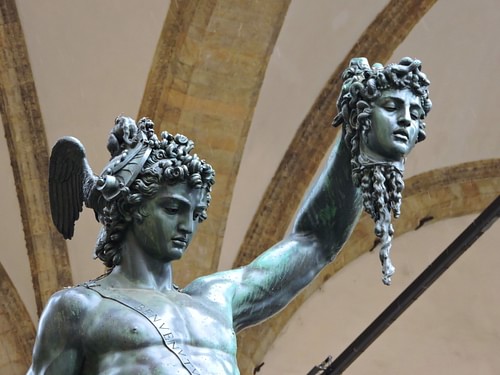

I have always taken delight in witnessing and growing familiar with every kind of expertiseHe manages a crew of a dozen technicians well, apparently mostly not with terror and threats.
I rode at her side upon a pretty little horse of mine, making signs to my servant that he should keep somewhat apart, which gave us the opportunity of discussing things that are not sold by the apothecary.(Condoms? Abortifacients?)
accusing him of using her “in the Italian fashion, that is to say, unnaturally like a sodomite... To this I answered that such was not the Italian way, and that on the contrary it must be the French way, since she knew all about it and not I
(He denies sodomy. But his omnisexuality is obvious.)
he was about fourteen; he was the son of a Roman citizen who lived on a private income. This Paulino had the most perfect manners, the most honest character, and the prettiest face of any I have ever come across in all my life. His honest way of behaving and his incredible beauty and the great love he showed me made me love him in turn almost more than I could bear... Whenever I took up the cornet such a frank, beautiful smile came over his face that I am not at all surprised at those silly stories the Greeks wrote about their gods. In fact if Paulino had been alive in those days he might have unhinged them even more.("I took a boy as a date! As a joke obvs")
a little maid of about thirteen or fourteen... I had the little maid, who was as fresh as fresh
our admirable president decided that the following Sunday we would all meet for supper at his house, and each of us was to bring what Michelagnolo called his crow [mistress] along with him. Whoever failed to do so would have to stand all the others a supper... I hit on a trick that would amuse everyone enormously... a young lad of sixteen who lived next door... a handsome boy, with a wonderful complexion, and his head was even more beautifully modelled than that of the ancient statue of Antinous... When he came in I asked him to let me dress him up in the woman’s clothes I had got ready. He was quite willing and put them on at once... After that I arranged some beautiful gold and richly jewelled necklaces round his neck, and adorned his lovely hands with rings... Michelagnolo stood up and said that one kissed the feet of the Pope but the cheeks of angels – and when he suited the action to the words the young man blushed furiously and looked more beautiful than ever. After this introduction, we discovered that the room was full of sonnets that we had written and sent to Michelagnolo. My young companion began to read them, and as he spoke them aloud – every one of them – his incredible beauty was so enhanced that I find it impossible to describe... in their concern for her, the two women started feeling Pomona’s body and discovered she was a male. They drew their hands away quickly, shot up from the table, and began insulting him, in words usually reserved for pretty young men. Immediately uproar broke out, and everyone started laughing and crying out in amazement. The stern Michelagnolo asked permission to give me the penance he thought proper and, when it was granted, with loud cries from everyone else he lifted me up and shouted: ‘Long live Benvenuto: long live Benvenuto.’
Despite starting at the bottom he is rarely an apprentice, instead a free contractor. One would have thought that the guild would stamp this out, but he never mentions a guild. Early on he loses a third of his takings to the workshop he rents, but that's it. Maybe he just ignored them and they rightly stayed clear of the psycho.
At one point, manning a cannon, he nearly kills a cardinal by accident. His response is typical: threaten anyone who reprimands him with cannonfire.
I trained two light cannon on the stairway, determined that whoever came up first would get the full force of one of them. "You useless fools – if you don’t clear off, if one of you dares climb up these stairs, I have two falconets ready and I’ll blow you to smithereens"
Later,
We all fired, twice in succession, and I looked cautiously over the wall. The enemy had been thrown into the most extraordinary confusion, because one of our shots had killed Bourbon... being perhaps more attracted to soldiering than to my real profession, and as a result I made a better job of it than I did of being a goldsmith... my shot struck the sword and cut him in two. The Pope who was taken by surprise was astonished and delighted... I was the man who let fire at Iscatinaro, for talking disrespectfully to the Pope, with brutal insolence, like the Lutheran and infidel that he was. When this happened Pope Clement had the castle searched, to discover and hang the man who did it...
...the French pox. In Rome, as it happens, this particular disease is very fond of priests – especially very rich priests
He invokes God frequently, but is happy to go larping black magic:
We went together to the Coliseum; and there the priest, having arrayed himself in necromancer’s robes, began to describe circles on the earth with the finest ceremonies that can be imagined. I must say that he had made us bring precious perfumes and fire, and also drugs of fetid odour... then he began his incantations. This lasted more than an hour and a half; when several legions appeared, and the Coliseum was all full of devils... he prayed me to stand firm by him, because the legions were a thousandfold more than he had summoned, and were the most dangerous of all the denizens of hell... I looked at Agnolino Gaddi, whose eyes were starting from their sockets in his terror, and who was more than half dead... hearing me laugh, he plucked up courage, and said the devils were taking to flight tempestuously.
the people of Normandy – or the majority of them – are in the practice of giving false testimony
Related to the Medici family (he married Piero de’ Medici’s daughter, Clarice) Filippo Strozzi... was
an active opponent of the Medici
Keep this open as you read; without images it's too easy to just laugh when people keep on talking about how e.g. his "salt-cellar" is a masterpiece, the most beautiful thing possible outside of paradise, etc.
If even three-quarters of this was false, we would still have to change our minds about how much a life can contain, how realistic the old epics and picaresques are.